Launch pricing: the full kit, 112 illustrated pages, is $27 while we're newLaunch pricing: full kit, 112 pages for $27
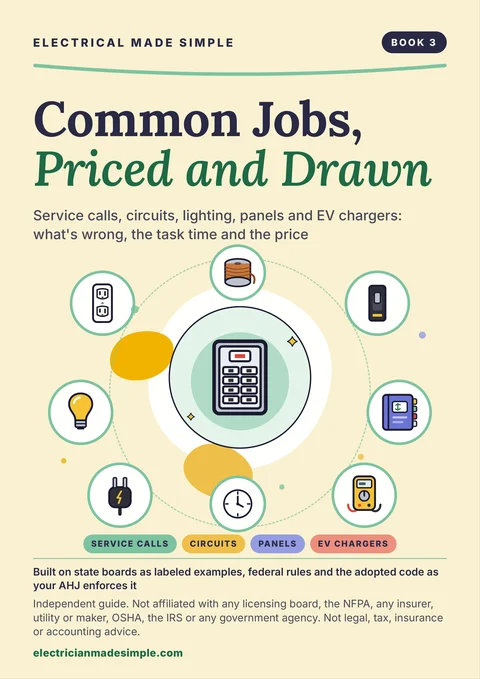
The Electrical Business cover Bidding, Selling and Running Jobs cover Common Jobs, Priced and Drawn cover

The Whole Electrical Business. Explained With Drawings.

Busy every day and still short? Three illustrated guides for running an electrical business: what a billed hour really costs, pricing and licenses; bidding, selling and running jobs; and 32 common jobs, priced. One idea a page, each one drawn.

Secure purchase No subscription 7-day guarantee

Here's what the pages look like

Real pages from all three guides. One idea a page, drawn, with the money worked out.

What's included

Three illustrated guides

The Electrical Business, Bidding, Selling and Running Jobs, and Common Jobs, Priced and Drawn. 112 pages, one idea each.

One idea, drawn

The idea, the picture, the numbers worked out and the costly mistake. Read it in the van between calls.

Made for your phone

Phone-sized PDFs to check at the kitchen table or on the job, yours to keep. Nothing to cancel.

You know the trade. Nobody taught you the money.

Most of the money an electrical business loses goes quietly: a rate set from your wage, half the day's hours that nobody pays for, a call fee mentioned only at the door, materials charged at what you paid, a callback that eats hours you could have billed. Every one of them has a page, and every page names the mistake.

The money pages: where electricians lose money

Matching a rival's $130 an hour, when at the kit's $188 cost every billed hour loses $58

Adding 20% to cost and calling it a 20% margin, when measured on the price it is only 16.7%

Charging a part at what you paid, so when it fails under your warranty the swap and the trip come out of your pocket

From Book 1 · Your costs

What a billed hour really costs

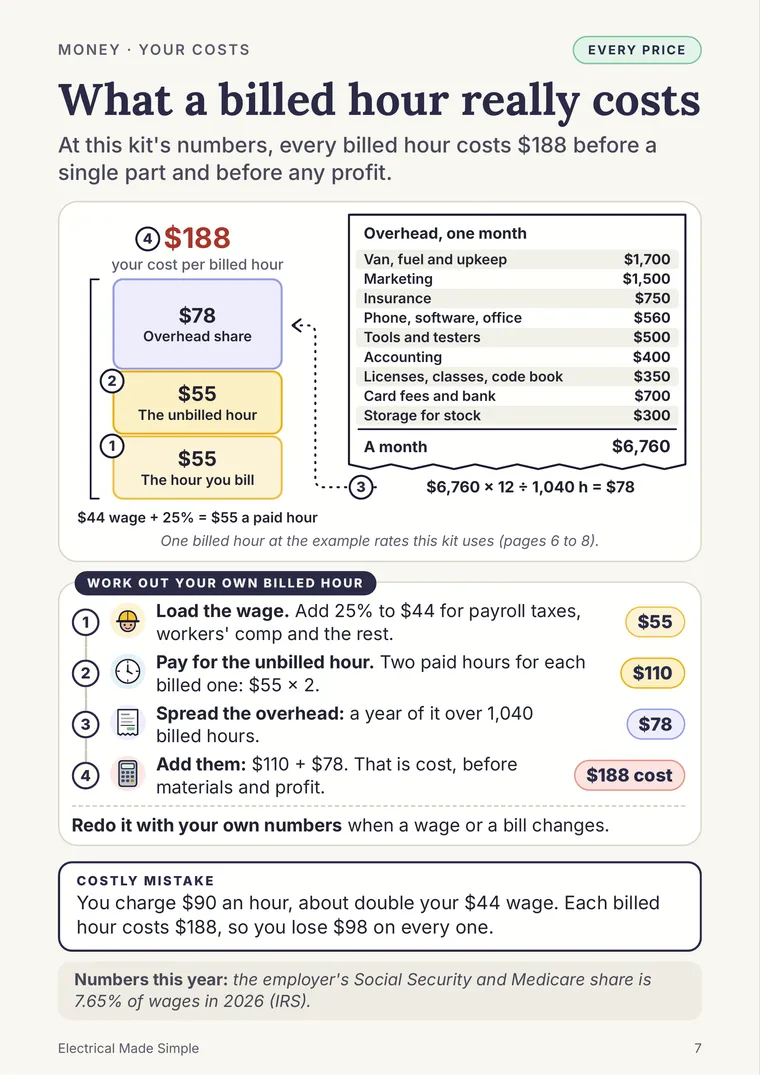
Book 1, page 7, What a billed hour really costs: at this kit's numbers, every billed hour costs $188 before a single part and before any profit
From Book 1 · page 7
The idea At this kit's numbers, every billed hour costs $188 before a single part and before any profit.
Costly mistake You charge $90 an hour, about double your $44 wage. Each billed hour costs $188, so you lose $98 on every one.

A drawing is easier to take in between calls than a paragraph. That's why every page in the kit has one, with the numbers worked out beside it.

Same van, same phone. A very different month.

From this

Learning it the expensive way

  • A group thread at midnight that argues with itself about what to charge for a panel swap
  • An hourly rate that sounds fair, and no number of your own to check it against
  • Finding out at the end of the year that the phone rang all day and you made nothing
To this

The page for this decision

  • One idea, one drawing, read in a minute
  • What it looks like on the job, on the same page
  • The costly mistake named, so you skip it instead of paying for it

One page, up close

Every page has the same parts, so you always know where to look. Here is Book 1, page 11, The flat-rate formula, line by line, with its lines quoted from the guide.

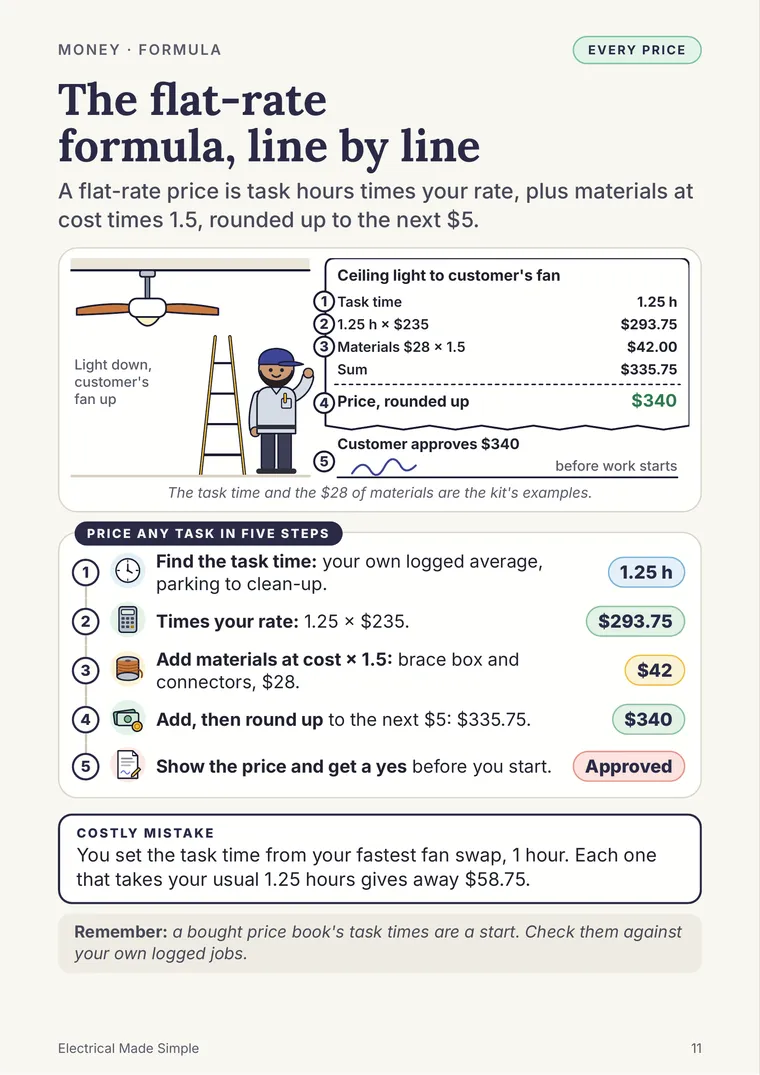
Book 1, page 11, The flat-rate formula, line by line: the whole page
The idea

A flat-rate price is task hours times your rate, plus materials at cost times 1.5, rounded up to the next $5.

Worked on the page

Times your rate: 1.25 × $235. Add materials at cost × 1.5: brace box and connectors, $28. Add, then round up to the next $5: $335.75.

Costly mistake

You set the task time from your fastest fan swap, 1 hour. Each one that takes your usual 1.25 hours gives away $58.75.

Remember

A bought price book's task times are a start. Check them against your own logged jobs.

Quoted word for word from Book 1, page 11. The 1.25-hour task time, the $235 rate, the $28 of materials, the 1.5 multiplier and the $340 price on the page are the kit's example figures, labelled as examples. Every page carries these parts plus the drawing, and where a rule changes from state to state, a note that says so.

The three guides

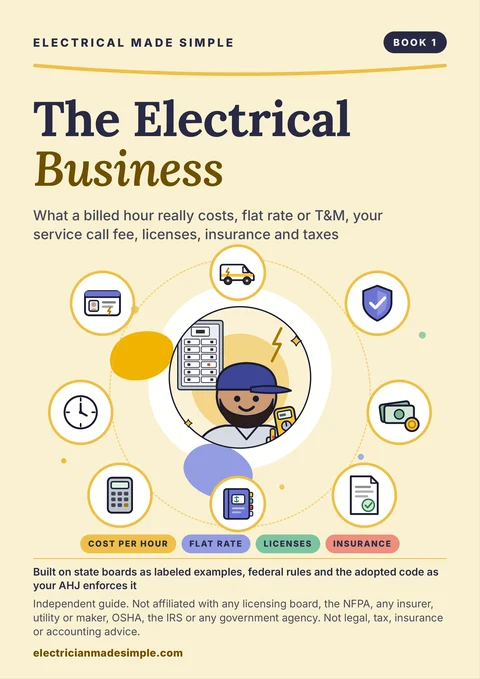
Book 1: The Electrical Business

39 teaching pagesEight partsEvery page drawnCosts, pricing and margin

Licenses, insurance, the money, setup, the paperwork, truck stock, taxes and your first hire, one idea a page. Eight parts: Starting out, Insurance and bonds, The money, Setting up, The paperwork, Truck stock, Taxes, and People, safety and growth. Start with what a billed hour really costs.

  • Starting out and insurance: what your business sells, the license ladder, three ways states license electrical shops, four policies an electrical shop carries, bonds and who they protect
  • The money: paid hours and billed hours, what a billed hour really costs, your selling rate, flat rate or T&M, the service call fee, the flat-rate formula line by line, materials, nights, weekends and emergency calls, quoted jobs, break-even, getting paid before you leave, your monthly profit and loss
  • Setting up and the paperwork: sole owner, LLC or corporation, your first-year setup checklist, keeping business money separate, permits, inspections and the AHJ, records to keep, the work order signed first, the three-day cancel rule, change orders, your warranty in writing, liens and your right to be paid
  • Truck stock, taxes and people: truck stock as money on shelves, restocking and charging every part, self-employment and quarterly taxes, sales tax on materials and labor, writing off the van and tools, employees, contractors and the 1099, your first hire, paying electricians, overtime and minimum wage, safety with shock, arc flash, ladders and attics, renewals and code cycles, when to add a second van
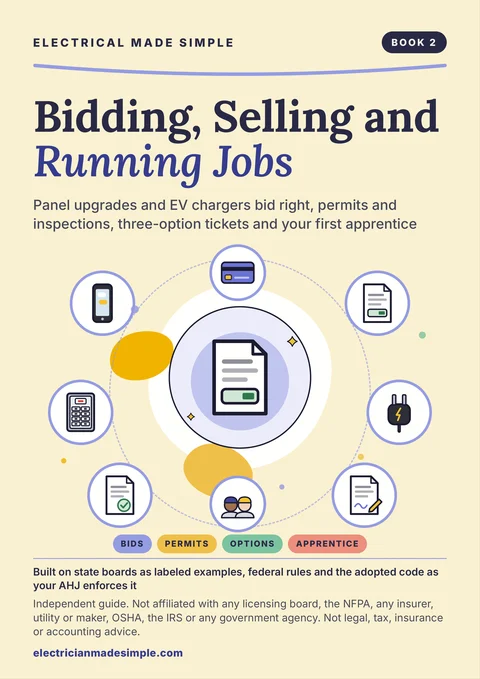
Book 2: Bidding, Selling and Running Jobs

37 teaching pagesFive partsEvery page drawnFirst call to final inspection

Getting the phone to ring, bidding panel upgrades, EV chargers and remodel wiring, permits and inspections, selling on the call and your first apprentice, in the same layout.

  • Getting calls: where electrical calls come from, your Google Business Profile, asking every customer for a review, a website that makes the phone ring, what a booked call costs you, builders, remodelers and property managers, the booking call step by step
  • Bids and quotes: why customers ask for a new panel, the site visit, pricing a panel upgrade line by line, the utility's part, the written quote, good, better, best, EV charger bids and circuits priced by distance, a full panel, credits and rebates, remodel wiring, bidding for builders, following up every open quote
  • Permits and inspections: the permit packet before day one, booking inspections without losing days, a failed inspection, closing the permit and handing over
  • On the job and the crew: the first five minutes in the home, finding the problem and showing it, three options on one ticket, recommending honestly, when the answer is no, payment and the review, financing a big job, what a callback really costs, registering and supervising an apprentice, what an apprentice does first, pricing a two-person crew, a first-year training plan

Book 3: Common Jobs, Priced and Drawn

36 teaching pagesSix partsEvery page drawnEvery job priced

The calls and jobs you run every week, one to a page: what the customer sees, what is usually wrong, the flow of the work, the task time, the materials and the flat-rate price at the kit's rates. Concepts and pricing, never wiring instructions: the adopted code, the maker's instructions and your inspector decide the technical detail.

  • How a job is priced: how each job page works, timing your own jobs, access time in attics, crawlspaces and plaster, when the fault hides
  • Service calls and circuits: half the house went dead, a breaker that keeps tripping, outlets dead in one room, lights that flicker, a warm outlet or switch, a burning smell, smoke alarms that chirp, GFCI receptacles, AFCIs and nuisance trips, two-prong outlets, adding an outlet or a dedicated circuit, outdoor and garage outlets, switches, dimmers and smart switches, surge protection, aluminum wiring repairs
  • Lighting and fans: swapping a light fixture, a ceiling fan where a light was, adding recessed lights, outdoor lights and sensors, the electrical part of bath fans
  • Panels and quoted jobs: a bad breaker or a bad panel, replacing a panel, adding a subpanel, storm damage at the mast, a generator inlet and interlock, a standby generator, an EV charger job end to end, plug-in or hardwired chargers, hot tub and spa circuits, heat pump and AC circuits, rewiring a whole house

Here's everything you get

Bidding, Selling and Running Jobs The Electrical Business Common Jobs, Priced and Drawn

The Electrical Made Simple Kit

  • The Electrical Business44 PDF pages, 39 teaching pages: licenses, insurance, what a billed hour costs, your selling rate, flat rate or T&M, the call fee, the paperwork, taxes and your first hire
    $45
  • Bidding, Selling and Running Jobs42 PDF pages, 37 teaching pages: getting calls, panel upgrades and EV chargers bid right, permits and inspections, three-option tickets, payment and your first apprentice
    $25
  • Common Jobs, Priced and Drawn40 PDF pages, 36 teaching pages: 32 common calls and quoted jobs, each with what is usually wrong, the task time, the materials and the flat-rate price
    $25

Total value: $95

Launch price
$27

One-time payment. No subscription. Keep the files forever.

Yes, I want the kit for $27
Secure purchase No subscription 7-day guarantee
Payments by Stripe

Digital guides (PDF), in English. We email your library link right after purchase, and you can download the files again anytime. Plus sales tax where applicable.

Electrical Made Simple is an independent guide for licensed electricians running a business. It explains rules in plain words, is not legal, tax, insurance or accounting advice, and does not promise any business result.

Is this kit for you?

Phone ringing, and the month still doesn't add up

The calendar is full and the account is still thin. Paid and billed hours, what a billed hour really costs, your selling rate, flat rate, materials, the call fee and break-even each get a page, worked with the kit's example rates you can swap your own into.

Still billing by the hour

Move to flat rate the way the book lays it out: your cost per billed hour, your selling rate, task times and a price for each job, signed before the work starts, with up to three honest options on the ticket.

Going out on your own

You hold the license; the business side is new. Book 1 lays out the license ladder and your state's pattern, insurance and bonds, the setup, permits, the work order and the cancel rule, then what a billed hour really costs before your first call.

How this kit is made

No gimmicks. Federal rules, state boards as labelled examples, the adopted code as your inspector enforces it and makers' instructions, drawn clearly, with the source named on the page where it matters.

Built on named sources

The tax, payroll and 1099 pages follow IRS publications and the overtime pages the Department of Labor's rules; the safety pages follow OSHA's electrical, lockout and ladder rules; the work order and cancel-rule pages follow the FTC's Cooling-Off Rule, and the review pages the FTC's rule on reviews and Google's own guidelines; the job pages describe the code your state and city adopt, never quote it, and point to the maker's instructions and your inspector; the license pages show state boards as labelled examples. Every page was checked against its named sources before release.

Honest about your state and city

Licenses, permits, code editions, sales tax on labor and lien deadlines change from state to state and city to city. Those pages teach the shared pattern, label any one rule as an example, and point you to where yours lives: your state's board, your local AHJ or the maker's instructions.

Example numbers, shown working

The money pages work the same example rates all the way through: a $44 wage that costs $55 an hour loaded, 2,080 paid hours and 1,040 billed, $188 of cost per billed hour, a $235 selling rate at a 20% margin, materials at cost times 1.5 and a $120 call fee. Book 3 prices every job with them. You can see where each number comes from and swap in your own. The examples are examples, not prices for your market.

Independent, on purpose

Not affiliated with or endorsed by the National Fire Protection Association (NFPA), any state or local licensing, electrical or contractor board, any building department or authority having jurisdiction, any electric utility, UL, the International Code Council, NECA, IEC, the IBEW, any insurer, surety, lender or home warranty company, any online platform, any maker of panels, breakers, devices, EV chargers, tools or testers, OSHA, the IRS, the Department of Labor, the Federal Trade Commission, Google or any government agency. NFPA 70, National Electrical Code and NEC are registered trademarks of the NFPA, used here only to name the code. We answer to the owner.

7-day money-back guarantee

Use the kit for 7 days. If it isn't for you, email us and you get 100% of your money back. No fine print, no hassle.

Questions, answered

How do I get it?

Right after purchase we email you a link to your library, where you download all three guides as PDFs. You can come back and download them again anytime.

Is this a one-time payment or a subscription?

One-time payment of $27. No subscription, no recurring charges, and nothing to cancel. All three guides are yours to keep.

Who is it for?

Licensed journeyman and master electricians starting or running a residential and light-commercial service business in their first few years, and electricians about to go out on their own. The kit covers service calls, small jobs, flat-rate pricing and a small shop with a van or two. It does not teach electrical work: it is the business side.

Which state is it for?

Every state. The books teach what works the same way everywhere: pricing, getting calls, insurance, getting paid and the calls themselves. Where a rule changes by state or city, like electrical licenses, permits, the code edition, sales tax on labor or lien deadlines, the page says so and shows you where to look up yours.

Is it legal or tax advice?

No. Electrical Made Simple is an independent guide for licensed electricians running a business. It explains rules in plain words, is not legal, tax, insurance or accounting advice, and does not promise any business result. Your lawyer, accountant, insurance agent and your state's licensing board apply the rules to your business.

Do I need to buy anything else?

No. The kit is complete on its own.

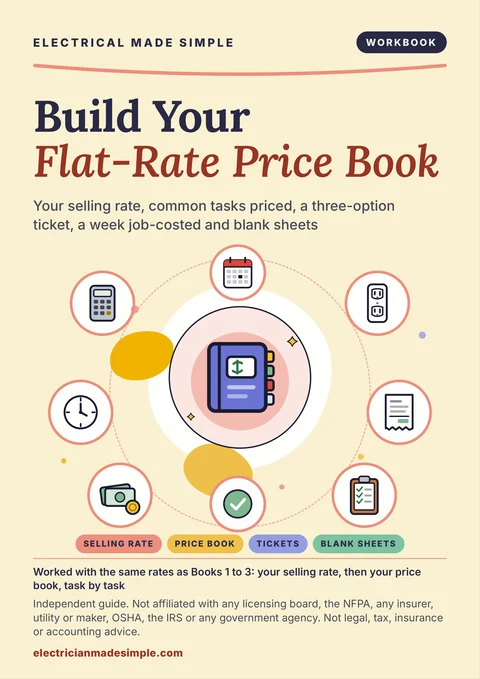
Build Your Flat-Rate Price Book cover

At checkout there is one optional add-on, Build Your Flat-Rate Price Book: your billed hour, selling rate and house rules worked out, common tasks priced one section at a time (devices, protection and safety, lighting and fans, circuits and outlets, adders and the night column), quoted jobs on one sheet, a three-option ticket, a week of calls checked against what it paid, and three blank sheets to copy. It's $9, unticked, and you can skip it.

Can I use it on my phone? Can I print it?

Both. The pages are portrait and phone-sized, so you can check one between calls, and the PDFs print if you want a page in the van.

Will it make my business profitable?

We don't promise that, and we'd be wary of anyone who does. The guides show you how each piece works and the mistake that costs money, with the numbers worked on the kit's example rates. Which jobs you take and what you charge is still your call.

What if it isn't for me?

Email us within 7 days of purchase and we'll refund 100% of your money. Details on the refund policy page.

One last thing before you decide

Every month on your own teaches you something about the business side, and the expensive lessons come with a bill. You don't need another midnight group thread or an hourly rate someone swears by. You need the page for this decision, with the money worked out and the mistake named. Built for owners who want a business that pays them back.

Get instant access
Access confirmed ·
Full kit$27
Get instant access
The full kit · $273 illustrated guides · 112 pagesGet instant access